

the lost art of glamour
What Old Hollywood Got Right About Dressing a Woman

I often find myself returning to old Film noir films and romances from the Golden Age of Hollywood. Maybe it is the nostalgia, the quiet romance, or the sense of glamour that feels lost now. Or maybe it is something harder to name, something you feel more than you can explain. The way women carried themselves. The way they were dressed. The way they were seen.
There was a time when a woman did not need to reveal much to be unforgettable. On screen, she moved with ease, allowing her clothes to move with her. Light caught the curve of her shoulder, the line of her waist, the softness of fabric as it followed her body. Nothing felt thrown together. Every detail was made with intention.
In an era shaped by the studio system, the image was carefully created. Actresses like Lauren Bacall, Grace Kelly, and Rita Hayworth were not simply dressed in costume; they were styled. Every silhouette, every fabric, every detail shaped the way they were seen on screen. It extended beyond the character and became something lasting. An aura. An impression that stayed with you.
Glamour was never about excess or drama. It was about refinement. About presenting femininity in a way that felt effortless, beautiful, and quietly captivating.
Modern fashion often leans toward comfort and ease. Athleisure, denim, sneakers. There is nothing wrong with that, but somewhere along the way, something more romantic started to fade.
What story is being told through what we wear?
There is an assumption that more equals allure. More skin, more detail, more effort. But what Old Hollywood understood is that allure does not come from excess. It comes from how something is shaped and styled.
Exposure is immediate. It shows everything at once, leaving little left to discover. Glamour feels different. It reveals itself slowly, guiding the eye instead of giving everything away at once.
That is where allure lives.
And it was never accidental.
During the Golden Age of Hollywood, spanning the 1920s to the 1960s, glamour was carefully constructed. Studios shaped the way their stars appeared through wardrobe, styling, and presence. Costume designers like Adrian and Travis Banton defined femininity through silhouette, proportion, and elegance. Film became a reference point for beauty, influencing how women dressed far beyond the screen.
Each decade refined this image. The 1930s favored fluid silhouettes, with bias-cut silk and satin gowns that skimmed the body, seen on Jean Harlow. The 1940s introduced sharper tailoring, with structured shoulders and defined waists worn effortlessly by Lauren Bacall and Rita Hayworth. By the 1950s, silhouettes became more defined, with cinched waists and full skirts influenced by Christian Dior and embraced by Grace Kelly and Audrey Hepburn.
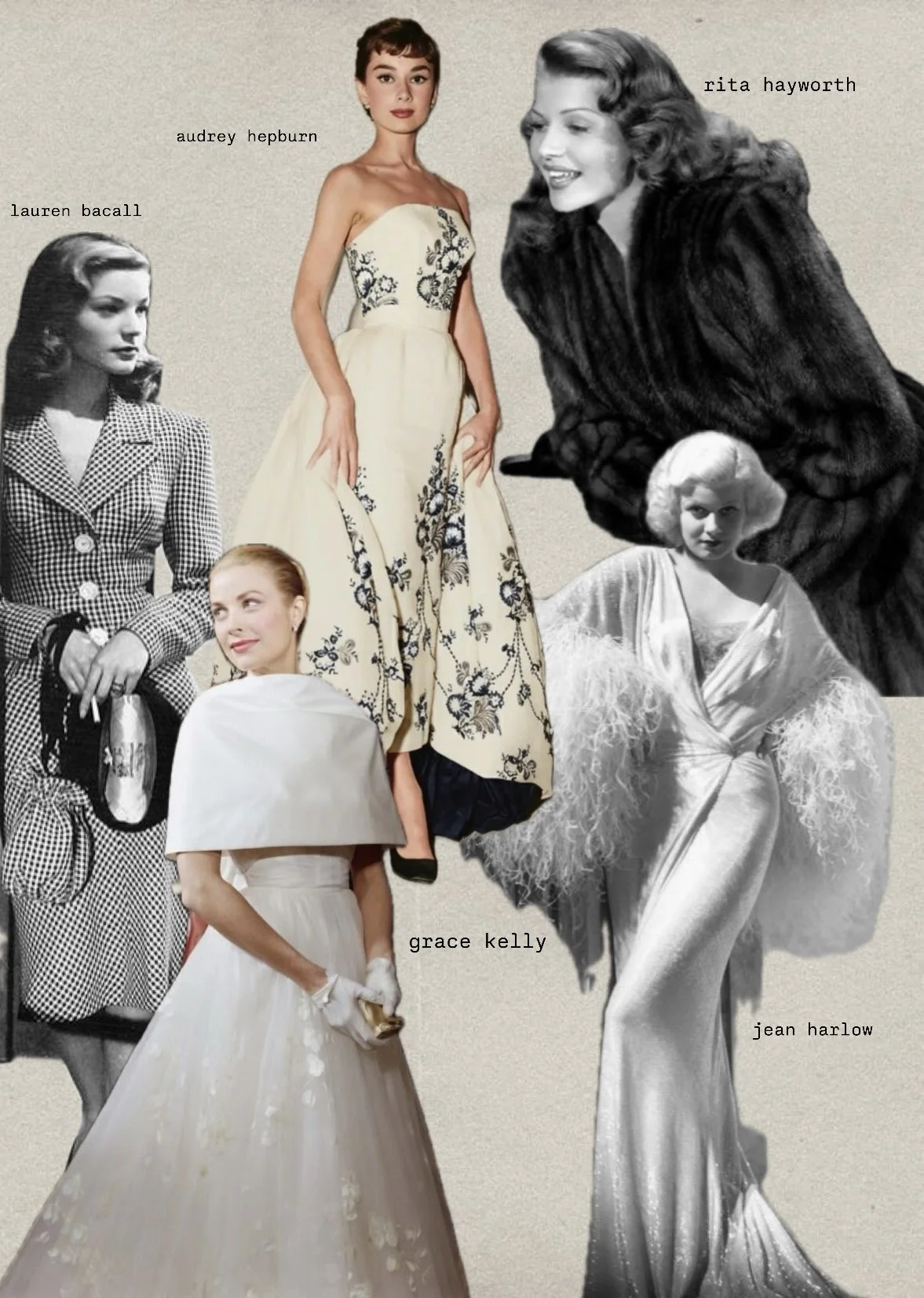
What tied these eras together was not excess, but intention. Hair was styled into soft waves or pin curls. Makeup emphasized contrast through defined lips and luminous skin. Fabrics were chosen for how they moved with the body, not just how they looked. Everything worked together. Nothing competed.
Rather than exposing the body, clothing was used to shape it.
The hourglass silhouette became a visual ideal not because it was always natural, but because it could be designed. Waists were gently defined. Shoulders were shaped. Hips were balanced. The result was a harmonious look while remaining feminine and natural.
What made these silhouettes so captivating was not just their shape, but their movement. Fabrics like silk, satin, and crepe did not cling or sit stiffly. They responded to the body, catching light and shifting subtly with every step.
The body was never fully outlined. It was suggested.
Coverage also played an important role. High necklines, long sleeves, and longer hemlines were not restrictive. They were part of the styling language. By limiting what was immediately visible, attention was naturally drawn to posture, movement, and silhouette.
The eye was guided gently, never overwhelmed.
Allure extended beyond clothing into the full look. Hair, makeup, and accessories were all considered together. Soft waves framed the face. Lips were defined but never overpowering. Jewelry and details were used sparingly, always supporting the overall look. Actresses like Veronica Lake embodied this balance effortlessly. Nothing felt forced, yet everything felt naturally composed.
Where everything is visible, there is nothing left to interpret. But where there is femininity and suggestion, there is curiosity.
Allure does not insist. It suggests, and it leaves a lasting impression.
Today, much of fashion moves toward immediacy. Trends prioritize visibility, speed, and impact, often at the expense of mystery and allure.
What is lost is not beauty, but intrigue.
Recreating this kind of glamour today is not about dressing in costume. It is about understanding the principles behind it and applying them in a modern way.
A structured blazer with a defined waist. A dress that skims the body without clinging. Length that allows for movement and proportion. Fabrics like silk, wool, satin, and crepe respond to the body rather than flatten it.
Styling becomes intentional and refined.
The goal is not to recreate the past, but to reinterpret it in a way that feels modern, elegant, and personal.
What Old Hollywood understood is that glamour was never about showing more or putting everything into one look. It was about revealing just enough to create beauty that lingers.
Allure was not created through excess, but through thoughtful shaping, femininity, and the quiet beauty of what is left unseen.
Old films from that era and the women who defined them made me realize that allure is not gone, only forgotten.
And perhaps, in bringing it back, we find a way to dress not for attention, but for something far more lasting: elegance, presence, and timeless allure.
-NF
